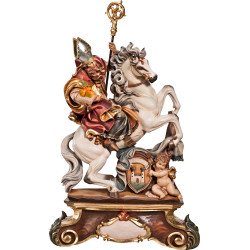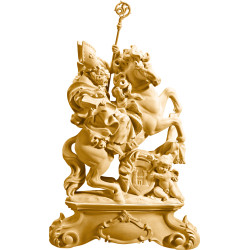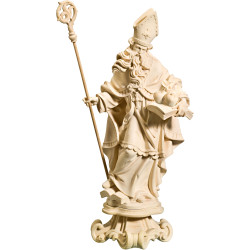
Saint Nicholas of Bari is one of the most beloved saints in the world. Known for his charity and kindness, he served as Bishop of Myra and became the source of countless legends. His feast on December 6 is still celebrated today, especially by children who keep alive the ancient tradition of his miraculous gifts.

Saint Nicholas of Bari is one of the most beloved figures in Christianity. He is considered the most important saint in the East after the Virgin Mary, and countless traditions and legends have arisen around his life. Historically, little is known with certainty, but his reputation for charity and mercy has endured through the centuries.
He was born in Patara in Lycia into a wealthy and devout Christian family. His mother was the sister of the Bishop of Myra, and his birth was regarded as a divine gift announced by a heavenly messenger. Nicholas received a strong Christian education and was ordained a priest by his uncle.
After the death of his parents, victims of the plague, Nicholas gave his entire inheritance to the poor, embodying from a young age the virtues of generosity and humility. He later became abbot of the monastery founded by his uncle, and according to tradition was chosen as Bishop of Myra when the clergy decided that the first man to enter the church would receive the office — and Nicholas was the one who entered first.
Those were difficult times for Christians, persecuted under Diocletian. Nicholas guided his community with courage and modesty, practicing fasting and sleeping on the ground. He was eventually arrested, abused and tortured, and was released only after Constantine legalized Christianity. Some accounts say that Nicholas took part in the Council of Nicaea in 325 AD.
His cult spread rapidly throughout the East and later to Europe, especially to Russia. In Italy, devotion to him increased greatly after his relics were brought to Bari in 1087, where a magnificent basilica was built to house them. It soon became one of the most important pilgrimage sites of the Middle Ages.
Many legends tell of his generosity. The most famous recounts how he saved three girls from being forced into prostitution by secretly throwing three bags of gold into their house. This miracle is the origin of the well-known symbols of the three golden spheres or three sacks of money. Today, children across Europe still await his gifts on the night of December 6.
Depicted as a bishop with a long white beard (in the East often bald), holding three bags of money, three golden spheres, three loaves, three gold bars, three apples, three boys, or with a ship, rudder, or anchor. Often included among the Fourteen Holy Helpers.
December 6
Of Russia, Switzerland, Lorraine, Amsterdam, Merano, Ancona, Bari, Trani, New York, of children, altar boys, students, girls, virgins, women desiring children, travelers, pilgrims, notaries, lawyers, judges, fishermen, sailors, millers, bakers, butchers, innkeepers, brewers, weavers, stonemasons, farmers, firefighters; for a happy marriage, for recovering stolen goods, against theft, and against dangers at sea and shipwrecks.
You might also like
Saint Nicholas of Bari is one of the most beloved saints in the world. Known for his charity and kindness, he served as Bishop of Myra and became the source of countless legends. His feast on December 6 is still celebrated today, especially by children who keep alive the ancient tradition of his miraculous gifts.