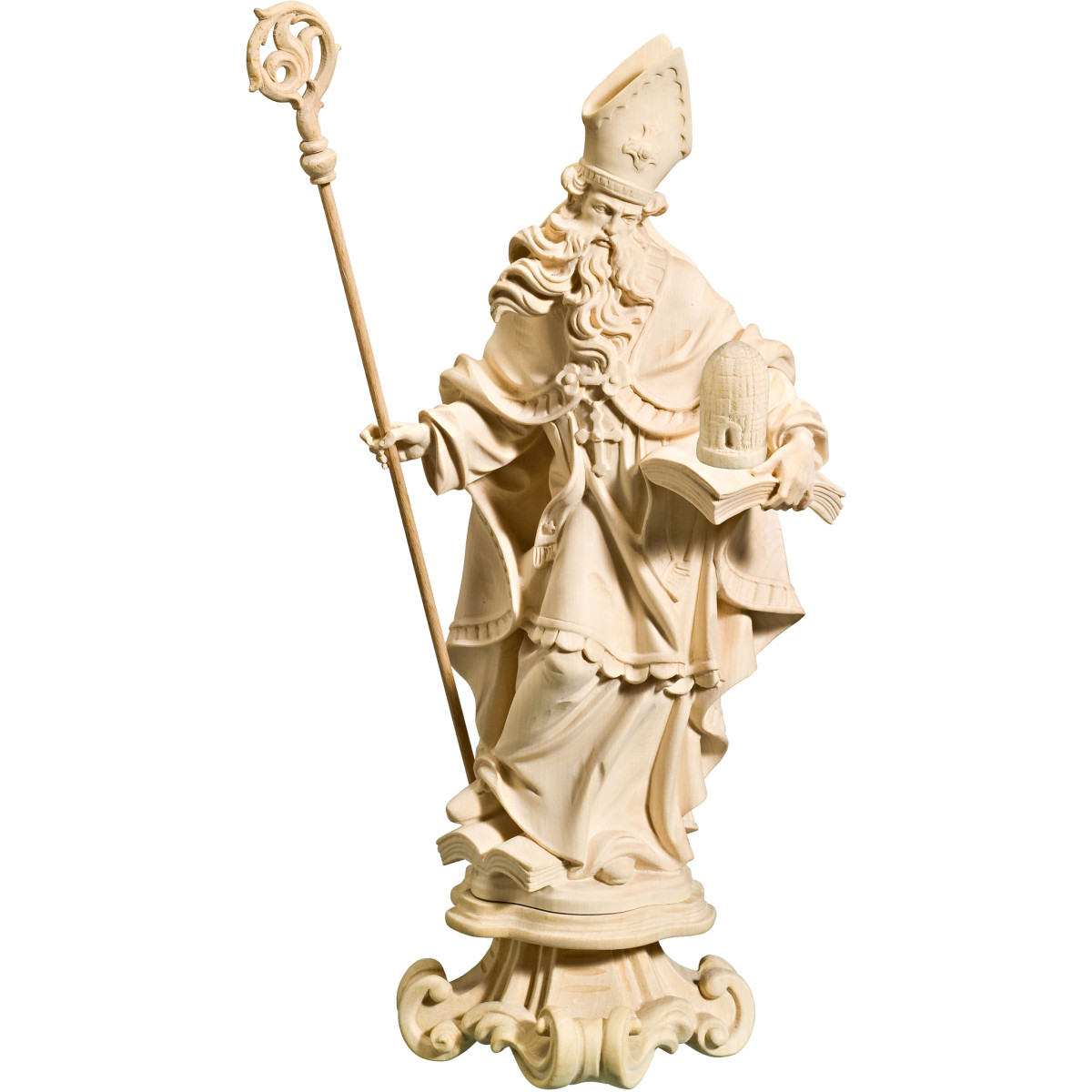
Saint Ambrose, one of the greatest Doctors of the Church, was bishop of Milan and a decisive spiritual guide of the 4th century. Known for his charisma, humility and courage, he converted Saint Augustine and defended justice with extraordinary strength. His feast is celebrated on December 7.

Saint Ambrose is the oldest of the four great Doctors of the Western Church and one of the most influential figures of early Christianity. His name, of Greek origin, means “the immortal” or “the divine”.
Ambrose was born around 339 A.D. in Treves, where his father served as a Roman prefect. Raised in a Christian family, he received an excellent education in law and rhetoric in Rome, where he moved with his mother and siblings after his father’s death.
His career led him first to Sirmium and later to become governor of Liguria and Emilia, with residence in Milan. When the Arian bishop Auxentius died in 347 A.D., the city was shaken by conflicts between Catholics and Arians. Ambrose attempted to restore peace, but during his speech, according to tradition, a child shouted his name under divine inspiration, and both factions unexpectedly agreed to elect him bishop.
The choice was astonishing: Ambrose was still a catechumen. He was baptized and, only a week later, on December 7, 374, he received episcopal consecration.
As bishop, Ambrose became renowned for his charisma, wisdom and generosity. He donated all his wealth to the poor and dedicated himself fully to the Church. A brilliant theologian and preacher, he decisively contributed to the conversion of Saint Augustine, who later considered him his master.
Ambrose deeply shaped Christian culture: he wrote theological works, hymns and liturgical texts, and is linked to the development of the Ambrosian Rite. He was also the first to use the term “Mass” to indicate the Eucharistic celebration.
Fearless and morally steadfast, he dared to confront Emperor Theodosius, imposing public penance after the massacre of Thessalonica — one of the most significant moments in the history of relations between Church and imperial power.
Saint Ambrose died in Milan on April 4, 397 A.D. and is buried in the basilica that bears his name. His letters, preserved to this day, reveal the extraordinary personality of this great bishop.
As a bishop or Doctor of the Church, seated at a writing desk, with a book, a pen, a dove, a scourge, a child in a cradle, a beekeeper’s hat or a beehive (linked to the famous legend of the bees).
December 7
Of Milan, Bologna, beekeepers, candlemakers, gingerbread sellers, bees, domestic animals, and for learning.
You might also like
Saint Ambrose, one of the greatest Doctors of the Church, was bishop of Milan and a decisive spiritual guide of the 4th century. Known for his charisma, humility and courage, he converted Saint Augustine and defended justice with extraordinary strength. His feast is celebrated on December 7.