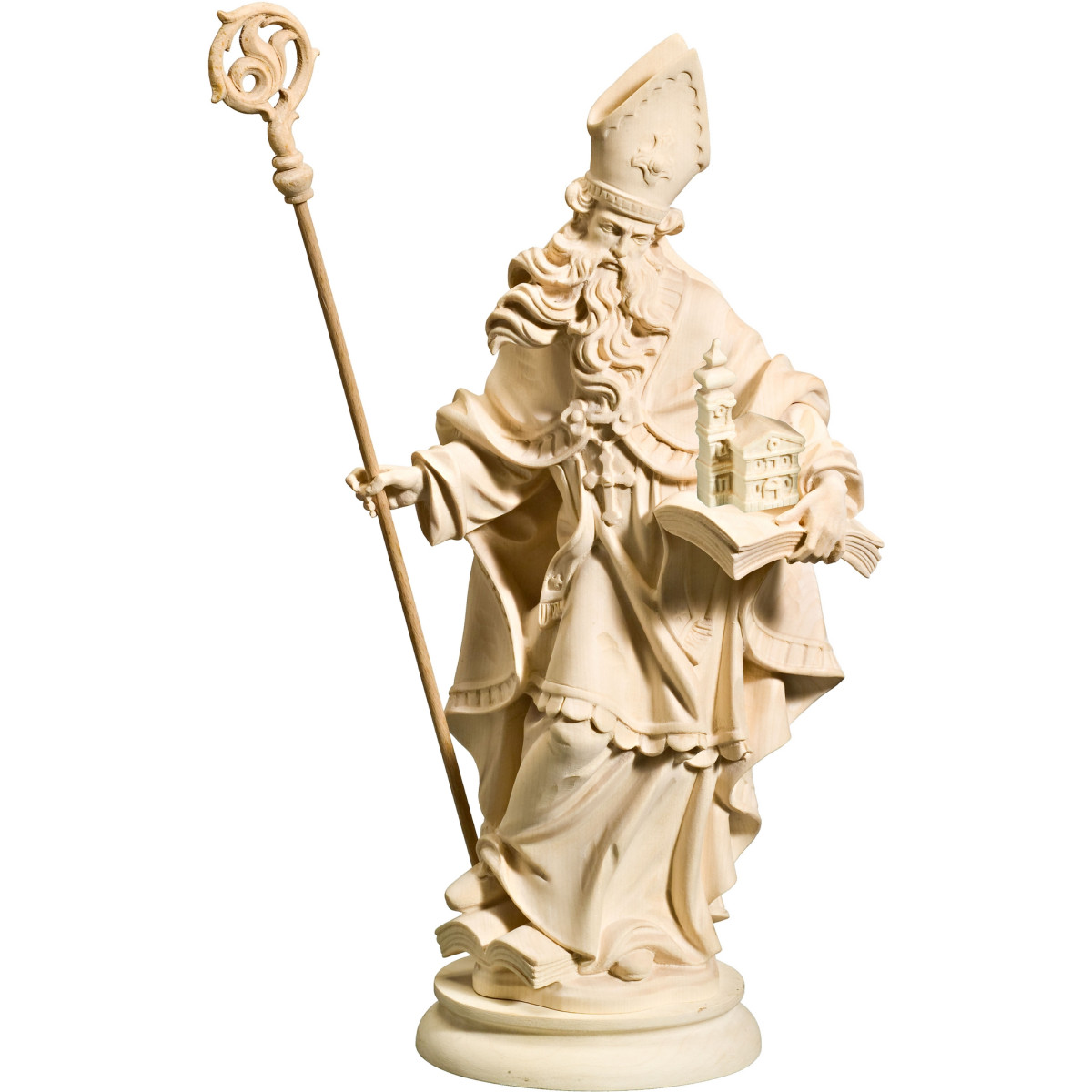
Statue of Saint Wolfgang, bishop and Benedictine reformer. Symbol of humility, faith, charity and spiritual renewal.

Saint Wolfgang was one of the most important and influential bishops of medieval Germany, known for his deep spirituality and commitment to Church reform.
He was born around 924 A.D. into a noble Swabian family, probably in the region of Pfullingen, in present-day Baden-Württemberg.
From a young age, he showed a strong inclination toward religious life and remarkable spiritual qualities.
For this reason, his parents sent him to study at the famous Benedictine monastery of Reichenau on Lake Constance.
When his friend and fellow student Henry became Archbishop of Trier, Wolfgang was appointed head of the cathedral school.
After Henry’s premature death in 964, Wolfgang chose to abandon worldly responsibilities and dedicate himself entirely to God.
He entered the Benedictine abbey of Einsiedeln in Switzerland, fulfilling a long-held desire.
He was ordained priest by Saint Ulrich of Augsburg, despite his reluctance due to his humility.
In 972, after an unsuccessful mission to evangelize the Hungarians, he was appointed Bishop of Regensburg with the support of Emperor Otto II.
He accepted the position out of obedience, maintaining a simple and humble lifestyle.
As bishop, he stood out for his charity, personally caring for the poor and the sick.
He promoted the construction of many churches, founded monasteries and worked for the education of the clergy.
He also reformed existing abbeys, contributing to the spiritual renewal of the Church.
One of his most significant acts was renouncing his rights over the diocese of Prague, allowing it to become independent and fostering the development of Christianity in Central Europe.
Saint Wolfgang died in 994 A.D. in Pupping, in present-day Upper Austria, during a journey.
Many towns in Germany and Austria bear his name, including the famous St. Wolfgang on Lake Wolfgangsee.
Iconography: Saint Wolfgang is depicted as a bishop or Benedictine monk, with an axe, book, pastoral staff, church model, sometimes with a wolf or the devil.
Feast day: October 31.
Patronage: Of Bavaria, the city and diocese of Regensburg, shepherds, carpenters, sculptors, sailors, woodcutters and invoked against illnesses and suffering.
Statue of Saint Wolfgang, bishop and Benedictine reformer. Symbol of humility, faith, charity and spiritual renewal.