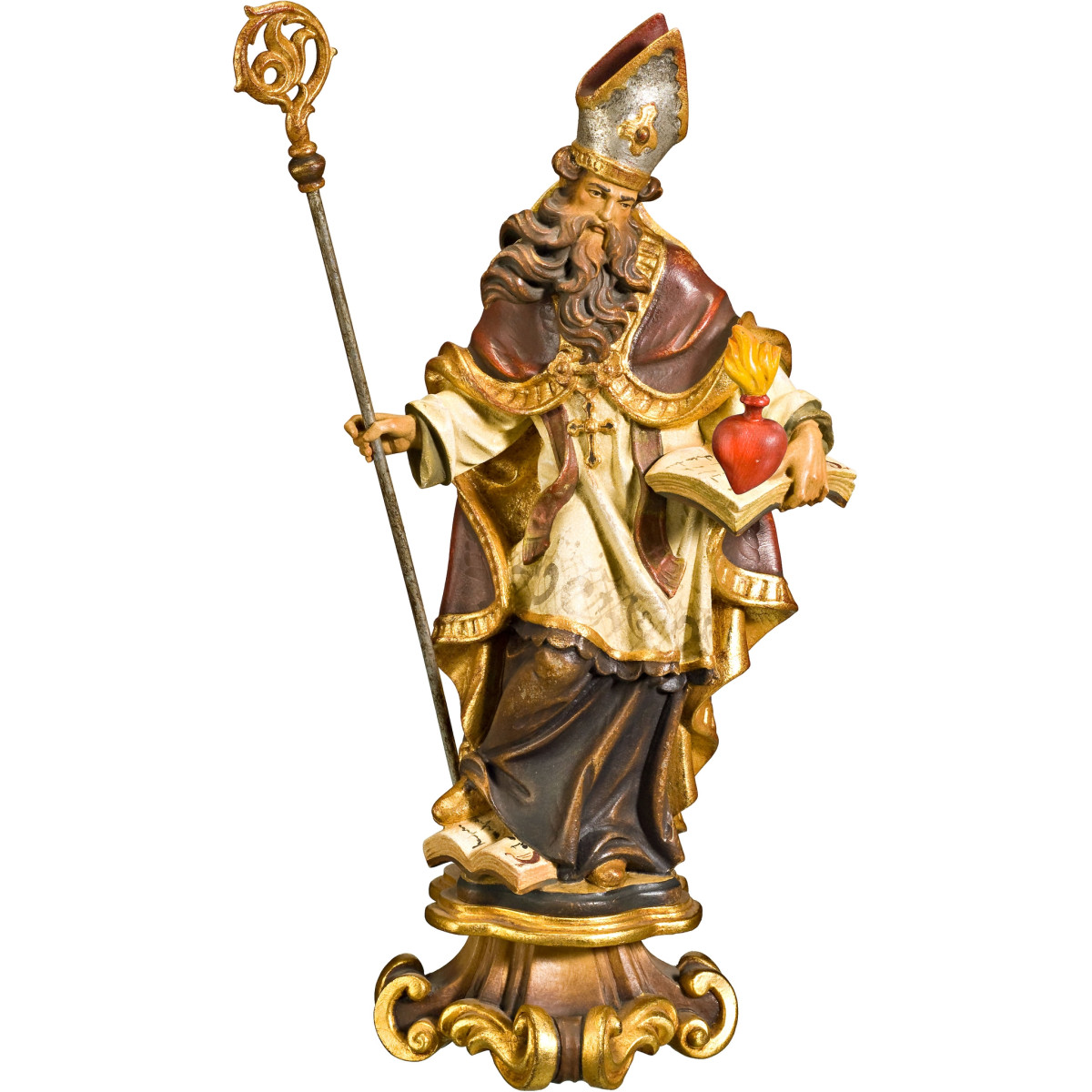

Saint Augustine, Bishop of Hippo and Doctor of the Church, is one of the most influential thinkers in Christian history. After a youth marked by restlessness and philosophical wandering, he converted thanks to the prayers of Saint Monica and the guidance of Saint Ambrose. His writings and the Rule of Saint Augustine shaped centuries of Christian theology and religious life.

Saint Augustine is one of the greatest theologians and philosophers in the history of Christianity, and the most influential of the four Latin Doctors of the Church. His life reveals a profound spiritual journey marked by searching, doubt, inner struggle and a powerful conversion that changed the course of Christian thought.
Born on 13 November 354 AD in Tagaste, Numidia, Augustine grew up in a Latin-speaking African Roman family. His mother, Saint Monica, was a woman of deep faith, while his father, Patricius, was a pagan who converted only shortly before his death. Gifted with great intelligence, Augustine received an excellent education aimed at a brilliant career in rhetoric or law.
As a young man, Augustine lived a restless life: he had a son, Adeodatus, and embraced different philosophical currents that led him away from Christianity. In 374 AD, he adhered to Manichaeism, causing sorrow to his mother. Without her approval, he left for Rome and later moved to Milan, where he obtained the prestigious chair of rhetoric.
Milan became the turning point of his life. Here he met Saint Ambrose, bishop of the city, whose sermons deeply touched him and awakened in him the desire for truth. In 387 AD, Augustine was baptized together with his son, in the presence of his mother, whose long prayers had finally been heard.
Returning to Tagaste, Augustine sold all his possessions, distributed the money to the poor and founded a monastic community. But his life changed again when, against his will, he was ordained a priest in 391 AD and then elected Bishop of Hippo in 396 AD. From that moment, he dedicated himself entirely to preaching, serving the faithful and defending the Christian faith.
He authored fundamental works such as the Confessions and The City of God, which shaped Western culture for centuries. He died in 430 AD during the Vandal siege of Hippo. His relics were later translated to Pavia, where they rest in the church of San Pietro in Ciel d’Oro.
Saint Augustine inspired the foundation of many religious communities following his Rule, centered on charity, harmony, communal life, renunciation, chastity, fasting and prayer. He remains a beacon of Christian spirituality and one of the great minds of all time.
Iconography:
as a bishop, as a scholar, enthroned, with crozier, with a book, with a child drawing water, with Jesus or an angel, with a flaming heart or pierced heart.
Feast day:
28 August
Patronage:
of Piombino, co-patron of Pavia, patron of theologians, printers, brewers, and for good eyesight.
You might also like
Saint Augustine, Bishop of Hippo and Doctor of the Church, is one of the most influential thinkers in Christian history. After a youth marked by restlessness and philosophical wandering, he converted thanks to the prayers of Saint Monica and the guidance of Saint Ambrose. His writings and the Rule of Saint Augustine shaped centuries of Christian theology and religious life.