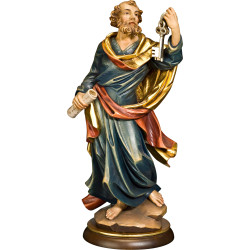
Statue of Saint Hedwig, Duchess of Silesia and great example of Christian charity. Patron saint of Silesia and married couples, symbol of devotion, humility, solidarity and Christian faith.
Saint Hedwig is one of the most important female figures of medieval European spirituality, remembered for her extraordinary charity, deep love for the poor and intense life of faith.
She was born around 1174 in Andechs and received her education at the Benedictine convent of Kitzingen on the Main River.
She was the daughter of Duke Berthold of Andechs and the aunt of the famous Saint Elizabeth of Thuringia.
At only twelve years of age she married Duke Henry I of Silesia, with whom she shared a happy and deeply Christian marriage.
Seven children were born from their union, and together they dedicated themselves to the Christianization of Silesia, supporting missionaries, monasteries and religious works.
The charity of Saint Hedwig was immense. She personally visited the poor, the sick and those in need to offer help and comfort.
Duke Henry deeply respected his wife’s generous nature, and together they lived a simple and modest life despite their noble status.
According to popular tradition, people jokingly said that it was better to be a poor person helped by the duchess than to work for her, so great was her generosity.
The two rulers also promoted the development and civilization of the region by encouraging the arrival of German farmers and founding new monasteries and religious institutions.
Saint Hedwig built numerous hospitals, shelters and charitable institutions, always showing great concern for those who suffered.
Her life, however, was also marked by profound suffering.
In 1238, her husband Henry and six of her seven children died. In addition, her family castle was destroyed and her sister was killed.
After these tragedies, Saint Hedwig decided to withdraw to the monastery of Trebnitz, present-day Trzebnica in Poland, near Wroclaw.
There she spent the final years of her life in prayer, penance and contemplation.
She died on October 15, 1243, in great solitude.
She was canonized in 1267 by Pope Clement IV, and her relics were placed in the Wawel Cathedral in Krakow, which became one of the main pilgrimage destinations dedicated to the saint.
Even today Saint Hedwig is venerated as a model of Christian love, generosity and dedication to the poor.
Iconography: Saint Hedwig is depicted as a young queen or duchess with a crown, lilies, a model church or image of the Virgin Mary; sometimes as a Cistercian nun, often barefoot carrying her shoes as a sign of humility.
Feast day: October 16.
Patronage: Of Silesia, Poland, Wroclaw, Trzebnica and Krakow, of exiles and married couples.

Statue of Saint Hedwig, Duchess of Silesia and great example of Christian charity. Patron saint of Silesia and married couples, symbol of devotion, humility, solidarity and Christian faith.