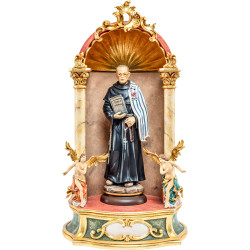
Statue of Saint Verena, Christian virgin and benefactress. Symbol of charity, care for the sick, humility and devotion to others.

Saint Verena is one of the most beloved and venerated saints in Switzerland, although most information about her life is based on tradition and legend.
According to tradition, she lived in the 4th century A.D. and was born in Thebes, in Upper Egypt, into a noble Christian family.
Verena joined the Theban Legion led by Saint Maurice, to whose family she was related.
She traveled to Italy to assist persecuted Christians, caring for prisoners and burying martyrs in Milan.
Later, she went to Agaunum (today Saint-Maurice in Switzerland) to bury Saint Maurice, who had been beheaded.
She then continued her journey to Solothurn, where she lived for a time in a cave, which was later transformed into a chapel and can still be visited today.
Verena became widely known for her healing gifts.
Many sick people came to her, and according to tradition, they were healed through her miracles.
Saint Verena also founded a community of women dedicated to caring for the poor and lepers.
Through her exemplary Christian life, she greatly contributed to the spread of Christianity among the Alemanni.
One day she was arrested by order of a Roman prefect hostile to Christianity.
When the prefect later fell ill, Verena miraculously healed him.
As a reward, she was freed but still sent into exile.
She settled in Tenedo (today Zurzach, Switzerland), where she worked as a housekeeper for a priest.
She continued to dedicate herself to those in need, carrying every day a water jug and a comb to wash and care for lepers outside the city walls.
She died around 350 A.D. in Zurzach, where her relics are still preserved today.
Over the centuries, her burial site became an important place of pilgrimage.
In the 5th century, a church was built over her tomb, followed by a monastery, later transformed into a seminary.
Among the most precious relics is also a finely crafted reliquary of her arm.
Iconography: Saint Verena is depicted as a virgin, hermit or nun, with a comb and a water jug, sometimes with bread or a fish.
Feast day: September 1.
Patronage: Of the poor, people in need, housekeepers of priests, fishermen and sailors.
You might also like
Statue of Saint Verena, Christian virgin and benefactress. Symbol of charity, care for the sick, humility and devotion to others.