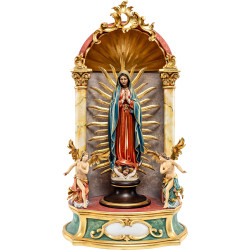
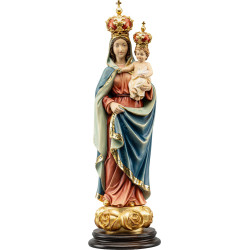
Statue of Our Lady of Guadalupe, inspired by the famous Marian apparitions of 1531 to Juan Diego on the hill of Tepeyac. Symbol of faith, conversion, reconciliation and Marian devotion.
Our Lady of Guadalupe is a representation of the Virgin Mary recalling the famous Marian apparitions that took place in December 1531 in Guadalupe. This sacred image is today one of the most important symbols of the Christian faith in the American continent and is venerated by millions of faithful around the world.
The Native American Juan Diego, one of the few Aztecs converted to Christianity and baptized with the name John, experienced several apparitions of the Virgin on the hill of Tepeyac, near Mexico City. Mary entrusted him with the mission of telling the bishop that a chapel dedicated to the Virgin should be built on the site of the apparitions.
The hill of Tepeyac was previously a place where the Aztecs worshipped Tonatzin, the goddess of harvest. For this reason, the bishop initially reacted with skepticism to Juan Diego’s story, fearing that the ancient cult still survived behind the appearance of Christianity.
The bishop therefore asked for a tangible sign proving the authenticity of the apparition. This happened on December 12, 1531, during the final meeting with the Virgin: on the snow-covered hill, thousands of colorful roses suddenly bloomed. Juan Diego gathered them in his cloak and returned to the bishop. When he opened the cloak before those present, the miraculous image of the Virgin Mary appeared. From that moment, the bishop had no more doubts and everyone knelt in prayer.
Only fourteen days later, the chapel at the foot of Mount Tepeyac was consecrated. Juan Diego spent the rest of his life living as a hermit near the sanctuary and died on May 30, 1548, at the age of 74.
In the following years, millions of indigenous people converted to Christianity. Within ten years, around eight million people embraced the Christian faith. The apparitions of Our Lady of Guadalupe brought about an extraordinary reconciliation between the Spanish conquerors and the indigenous peoples, uniting former enemies within the same Catholic Church.
From the union between indigenous people and Spaniards came the population of the mestizos, who today make up a large part of the Mexican people. In 1737, Our Lady of Guadalupe was proclaimed Patroness of Mexico.
Thanks to the priest Miguel Hidalgo, in 1810 the liberation movement against Spanish occupation was born with the famous motto: “Long live Mexico, long live Our Lady of Guadalupe!”, which eventually led to the country’s full independence in 1921.
Today, Guadalupe is home to the great Basilica of Our Lady of Guadalupe, built between 1974 and 1976. The basilica can accommodate up to 40,000 faithful and is one of the largest churches in the world. With more than twenty million pilgrims every year, Guadalupe is the most visited Catholic shrine in the world.
The cloak of Juan Diego bearing the image of the Virgin Mary still exists today and is considered one of the most extraordinary relics of Christianity. Researchers have confirmed that it is not a traditional painting, since no brushstrokes can be identified. Furthermore, despite the passing of centuries, the colors have not faded. Some researchers have also discovered microscopic reflected images in the Virgin’s eyes that seem to portray the people present at the miracle of 1531.
Iconography: Our Lady of Guadalupe is depicted with a starry mantle, pink tunic and hands joined in prayer.
Feast day: December 12.
Patronage: Patroness of Mexico and the Americas, invoked as a symbol of unity, peace, hope and conversion.

You might also like
Statue of Our Lady of Guadalupe, inspired by the famous Marian apparitions of 1531 to Juan Diego on the hill of Tepeyac. Symbol of faith, conversion, reconciliation and Marian devotion.