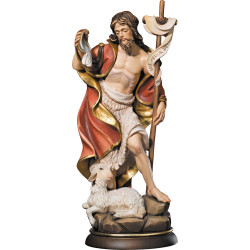
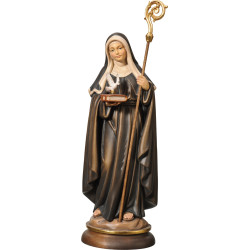
Statue of Saint Ulrich, bishop of Augsburg and great medieval spiritual guide. Symbol of humility, Christian faith, protection and pastoral wisdom.

Saint Ulrich, also known as Uldaric, Ulderic or Udalric, was one of the most important bishops of the German Middle Ages and a figure of great spiritual and political significance in Church history.
He was born around 890 A.D., probably in Kyburg, Switzerland, or in Augsburg, son of Hupaldo of Dillingen and his wife Thetpirga.
From an early age he was prepared for religious life and was sent to the Abbey of Saint Gall in Switzerland to receive a solid spiritual and cultural education.
After the death of his father, however, he was forced to return to Augsburg. In 908 A.D., his uncle Adalbero, bishop of the city, officially introduced him to the priesthood and entrusted him with important administrative responsibilities connected with the goods of the diocese.
In 909 A.D., while Ulrich was on pilgrimage in Rome, he learned of the death of his uncle Adalbero. Despite his young age, Pope Sergius III wished to appoint him bishop of Augsburg and successor to his uncle.
Out of humility and a strong sense of responsibility, Ulrich initially refused the episcopal office. Nevertheless, the pope foretold that one day he would still receive this task, although he would find the diocese in a very difficult condition.
When he returned to Augsburg, a new bishop, Hiltine, had already been elected. For fourteen years Ulrich devoted himself to his family, administered his inherited estates and cared for his mother.
In 923 A.D., after the death of Hiltine, King Henry I of Germany finally appointed Ulrich as the new bishop of Augsburg, thus fulfilling the prophecy of Pope Sergius III.
The situation of the city was extremely difficult because of the Hungarian invasions. To protect Augsburg, Saint Ulrich ordered the construction of a great stone wall around the city.
He also supported King Otto I militarily, contributing to the decisive victory against the Hungarians in 955 A.D..
Saint Ulrich quickly became known for his wisdom, discipline and spirituality. Through skilled diplomacy he also promoted reconciliation between Otto I and his son Liudolf.
Despite his political and religious importance, he always continued to live simply and humbly, dedicating himself to the poor and the needy.
He was a great preacher and promoter of religious life: he rebuilt numerous churches, supported monasticism and encouraged the growth of the clergy.
Saint Ulrich died on July 4, 973 A.D., after fifty years as bishop, during which he spiritually guided the people and courageously defended the city of Augsburg.
He was buried by his friend Wolfgang of Regensburg in the Church of Saint Afra in Augsburg, today known as the Basilica of Saint Ulrich and Saint Afra.
In 993 A.D., Saint Ulrich was officially canonized and became the first saint to be canonized by a pope through a formal canonization process.
For many centuries he was one of the most venerated saints of Western Europe, and many popular traditions developed around him, such as the Cross of Saint Ulrich, the Fountain of Saint Ulrich and the Water of Saint Ulrich.
Iconography: Saint Ulrich is depicted as a bishop with the Gospel, a fish, rats or a horse.
Feast day: July 4.
Patronage: Of the diocese and city of Augsburg, vintners, fishermen, weavers, travelers and hikers; invoked against fever, rabies, floods, plagues of rats and mice, and difficult childbirth.
Statue of Saint Ulrich, bishop of Augsburg and great medieval spiritual guide. Symbol of humility, Christian faith, protection and pastoral wisdom.